Services
Five engagement models, from products we own outright to short advisory work. Each one has a named owner, a written scope agreed before build, and a live task board you can open at any time.
Engagement models at a glance
| Service | Engagement shape | Typical duration | Who owns delivery | Example |
|---|---|---|---|---|
| Internal products | We fund and own it | Ongoing | One M product team | KHEL |
| Client software builds | Fixed scope, phased | 12–30 weeks | Named delivery lead | Yeti Fares |
| ERP & systems design | Discovery, then phased build | 20–48 weeks | Product analyst + delivery lead | Seven Summit Treks |
| Embedded operations | Retainer · embedded seat | 6 months minimum | An owner inside your team | 1M Fleet |
| Consulting & advisory | Retainer or fixed engagement | 4–16 weeks | Senior advisor | YakSure |
Scroll the table sideways →
Indicative planning ranges, not quotes. They assume timely access, content, and approvals, and every engagement gets a dated schedule in writing before build starts.
Internal products
The products in our own house. We fund them, build them, ship them, and operate them — which means we carry every consequence of a bad decision ourselves. It is the discipline that keeps the client work honest.
- Product strategy and a roadmap we commit to
- Web, mobile, and the admin back office behind them
- Launch, app store submission, and the operations after
- The metrics that say whether it is working

Founders and operators who want a partner that has actually shipped and run a product, not just delivered one.
Client software builds
You need a product built and you want one team accountable for it. We run discovery, design, build, and launch — and we are still there the week after go-live, when the real problems show up.
- Discovery and a written, agreed scope
- Design and build across web, mobile, and API
- A live, shared task board you can open any time
- Launch, handover, documentation, and warranty support
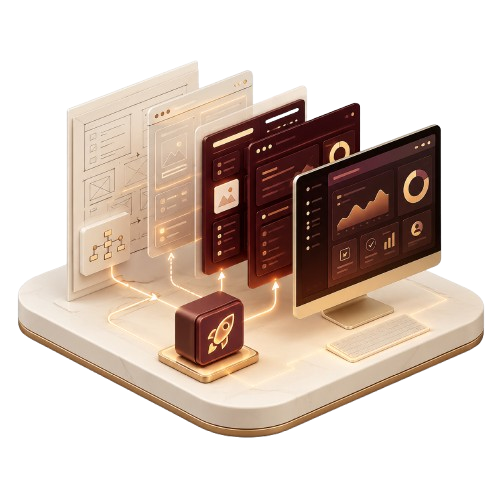
Companies with a clear business to run and no software team to run it on.
ERP & systems design
When an operation has outgrown spreadsheets and five disconnected tools. We sit with every department before writing code, map how the work actually moves, then build the system that carries it.
- Department-by-department discovery and workflow mapping
- System architecture and a role and permission model
- The ERP build, module by module
- Training, handover, and the runbook to operate it
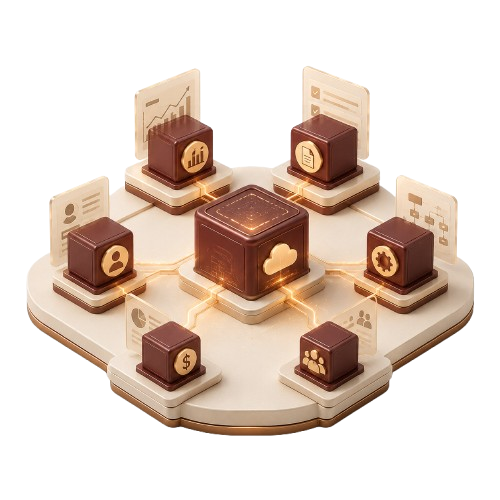
Multi-department operations running on spreadsheets, WhatsApp, and institutional memory.
Embedded operations
Sometimes the gap is not software — it is that nobody owns the operation. We put a person in the seat: product manager, operations lead, analyst. They report into your business and are accountable for the outcome, not the hours.
- An embedded owner in the seat, not a consultant on a call
- Process design and the tooling to run it
- Hiring, onboarding, and day-to-day management where needed
- Weekly numbers, and someone answerable for them

Businesses that need the function run, not advised on.
Consulting & advisory
Shorter, sharper engagements. A second opinion on an architecture, a product strategy that has stalled, an AI adoption plan that has to survive contact with a real team — or the marketing and sales engine to put behind what already exists.
- Product and platform strategy
- Systems and architecture review
- AI adoption planning that fits the team you have
- Marketing, positioning, and sales execution

Teams with the capability in-house who need direction, a review, or a growth engine.